Menopausal Skin: Why Taking Collagen Is Not the Same as Maintaining Collagen
Written by N. Streawbridge| 29 April 2026
A common menopausal skin concern we see in clinic — and why loss of elasticity is about far more than collagen alone.
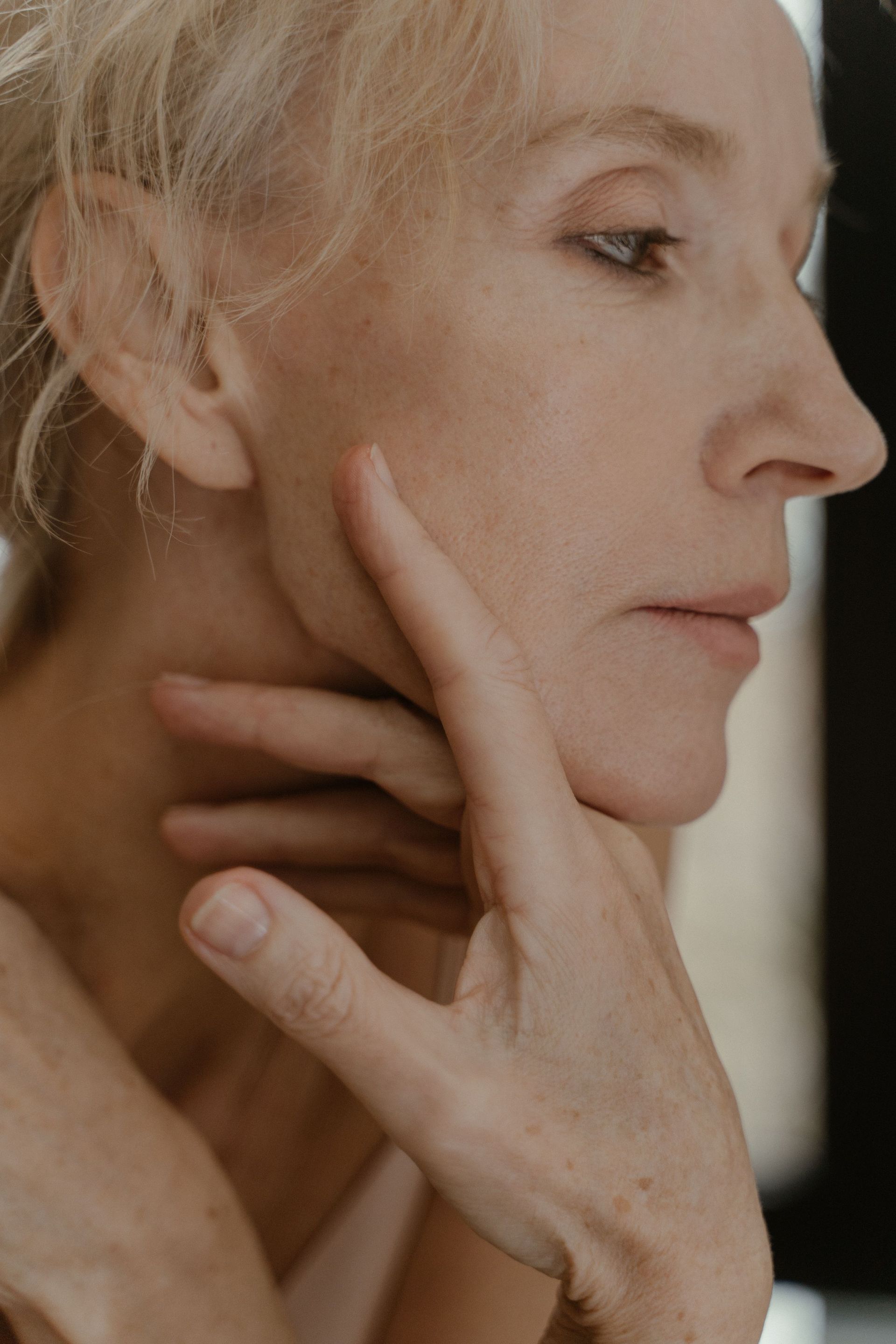
Collagen supplements have become almost synonymous with ageing skin. As skin becomes thinner, drier or less elastic around menopause, it can seem logical to reach for a collagen powder: collagen is declining, so perhaps we simply need to put more collagen back in.
But skin biology is more complicated — and much more interesting — than that. Taking collagen is not the same as maintaining collagen. And when a woman comes to us because her skin seems to be losing firmness and elasticity after menopause, simply recommending collagen misses an important first step: Why is her skin changing?
What happens to our skin around menopause?
Skin is a hormonally responsive organ, and oestrogen has important effects on its physiology.
Oestrogen receptors are present in several skin cell populations, and oestrogen signalling influences fibroblasts, keratinocytes, vascular function, wound healing, collagen homeostasis and other aspects of tissue maintenance.
As ovarian oestrogen production declines through the menopausal transition, the biological environment in which these cells operate changes. Research describes menopausal skin as becoming more prone to dryness, thinning and atrophy, wrinkling, sagging, reduced vascularity and slower wound healing.
One of the most important cells in this story is the fibroblast. Fibroblasts live within the dermis and help produce and remodel collagen, elastic fibres, proteoglycans and other components of the extracellular matrix. And that extracellular matrix is not simply scaffolding. It is the highly organised structural environment that gives skin much of its strength, resilience and mechanical behaviour.
So menopausal skin ageing isn't simply a story of having “less collagen”. It involves changes in the biological system responsible for producing, maintaining, protecting and organising the matrix in which collagen exists.
Before recommending collagen, we ask why
When a woman tells us that her skin is becoming less elastic after menopause, our first question isn't: “Which collagen supplement should she take?” It is: “Why is her skin changing?”
Menopause may be an important part of the picture, but it isn't necessarily the whole explanation.
Has the change been gradual or sudden?
A gradual alteration in skin thickness, hydration and elasticity may fit with chronological and hormonal ageing.A dramatic change over a short period deserves a broader look.
Has there been rapid or significant weight loss?
Loss of subcutaneous facial fat and other structural changes following substantial weight loss can alter facial contours and produce an appearance of laxity. That is a different problem from simply having insufficient collagen. And adding collagen powder cannot restore lost facial volume.
Is she eating enough?
We need adequate energy and protein to maintain and repair tissue. We also need the nutritional cofactors required for normal connective-tissue biology. Vitamin C, for example, is required for normal collagen synthesis. So before reaching for a specialist supplement, it is worth asking whether the body has the basic nutritional resources required to maintain tissue.
What has her lifetime UV exposure been?
This is enormously important.
Ultraviolet radiation is one of the major environmental drivers of skin ageing. Chronic UV exposure alters fibroblast behaviour and extracellular-matrix turnover and promotes pathways involved in collagen degradation. Menopause does not erase the accumulated effects of decades of sunlight.
Is the skin particularly dry or barrier-impaired?
A woman may describe her skin as suddenly looking “old”, crepey or less elastic when part of what we are seeing is a substantial deterioration in hydration and barrier function. That requires attention in its own right.
What else is happening?
We also consider smoking, alcohol intake, sleep, stress, general dietary quality, medications and wider health. New, rapid or otherwise unexplained skin changes may warrant appropriate medical assessment rather than being automatically attributed to menopause.
And we consider the woman's menopause as a whole. If she has wider menopausal symptoms, discussion of menopausal hormone therapy with an appropriately qualified medical practitioner may be relevant.
There is evidence that menopausal hormone therapy can influence skin collagen, thickness and elasticity, but MHT is not recommended solely as a cosmetic treatment for skin ageing. Decisions about it need to be based on the woman's overall health, symptoms, individual risks and potential benefits.
This assessment matters because two women complaining of “loss of elasticity” may have quite different biological problems — and therefore need very different approaches.
So where does collagen supplementation fit?
This is where the evidence becomes interesting. Several earlier trials and meta-analyses reported improvements in skin hydration and elasticity following oral hydrolysed collagen.
A 2023 systematic review and meta-analysis, for example, included 26 randomised controlled trials involving 1,721 participants and reported statistically significant improvements in hydration and elasticity. The authors also identified biases within the available trials and called for larger studies.
But newer evidence has made the picture less certain.
A 2025 systematic review and meta-analysis specifically examined factors including study quality and pharmaceutical-industry funding. Although the pooled studies initially appeared to favour collagen supplementation, the apparent benefits were no longer demonstrated when the researchers separately analysed higher-quality studies. The authors concluded that the available clinical evidence did not support collagen supplements for the prevention or treatment of skin ageing.
So I don't think the correct message is: “Collagen supplements don't work.” Nor is it: “Everyone over 50 should take collagen.” The evidence is more nuanced than either claim. Certain collagen preparations have produced measurable effects in clinical studies, but the overall evidence base is inconsistent, with important questions around study quality, product differences and funding.
Collagen therefore may be one optional component of an approach to ageing skin. But it is certainly not the whole answer. Because even if we provide collagen-derived peptides and amino acids, the skin still has to know what to do with them.
Taking collagen is not the same as maintaining collagen
Imagine delivering building materials to a construction site. The materials may be useful.
But having timber, bricks and cement sitting outside does not mean that a functioning building will appear. You still need the builders. You need instructions. You need energy. You need communication between different trades. You need the structure to be assembled correctly. And once the building exists, you need to protect and maintain it.
Our skin is considerably more sophisticated than a building, but the analogy illustrates the problem. Providing substrate is not the same as maintaining biological organisation.
That gives us a much more useful framework for menopausal skin.
1. BUILD: Does the body have the materials required to maintain connective tissue?
Collagen is a protein. Adequate overall dietary protein therefore matters. Collagen peptides may contribute particular amino acids and peptides, but they should not be expected to compensate for inadequate overall nutrition.
Vitamin C is also essential for normal collagen biosynthesis. And connective tissue exists within a much wider nutritional and metabolic environment.
So before concentrating on a specialist “beauty supplement”, we should ask a much more fundamental question: Does this woman have sufficient nutritional resources to maintain and repair tissue? That means looking at the diet as a whole rather than assuming that adding one isolated supplement corrects the problem.
2. SIGNAL: Are the cells responsible for maintaining the skin receiving the right instructions?
This is perhaps the most interesting part of menopausal skin biology. Fibroblasts are not passive collagen factories. They are living, responsive cells. Their behaviour is influenced by hormones, growth factors, inflammatory mediators, mechanical forces, neighbouring cells and the condition of the extracellular matrix surrounding them.
Oestrogen is part of that signalling environment. Following menopause, reduced oestrogen signalling is associated with thinner skin, lower collagen, reduced elasticity, dryness and other changes in skin physiology. So imagine that we provide plenty of collagen-derived amino acids.
Those materials are available. But the cellular signalling environment governing tissue maintenance has changed.
This is why postmenopausal skin cannot sensibly be understood simply as a collagen deficiency.
The issue may involve not only whether building materials are available, but whether the biological instructions governing their use have changed. That distinction matters enormously.
3. PROTECT: Are we protecting the collagen that is already there?
Maintaining collagen isn't simply about making more. It is also about regulating its breakdown.
Collagen is continuously remodelled. Enzymes called matrix metalloproteinases — MMPs — participate in normal extracellular-matrix turnover.
But ultraviolet exposure, oxidative stress and inflammatory signalling can alter these pathways and contribute to excessive matrix degradation. This is particularly important in photoageing. And it creates an obvious contradiction: We can take collagen every morning while simultaneously exposing our existing collagen to one of the strongest environmental drivers of its degradation.
That is why sensible photoprotection remains one of the most important evidence-based strategies for preserving ageing skin.
The expensive collagen powder cannot compensate for chronic unprotected UV exposure. Protecting what we already have matters just as much as trying to produce more.
4. ORGANISE: Skin elasticity isn't just about collagen
This is another important misconception. Collagen and elasticity are often spoken about as though they are interchangeable. They aren't.
Collagen contributes substantially to the skin's tensile strength and structural integrity.
But its elastic behaviour also depends upon the elastic-fibre network, including elastin and fibrillin-associated structures. And the extracellular matrix contains far more than collagen and elastin.
It includes proteoglycans, glycosaminoglycans such as hyaluronic acid, water and numerous structural and signalling molecules arranged within a highly organised three-dimensional environment. The relationships between these components matter.
Healthy skin is therefore not simply a bag containing a certain quantity of collagen. It is an organised living matrix. And this may be one of the most important concepts when thinking about ageing.
The biological objective is not merely to manufacture molecules. It is to maintain their correct structure, relationship and organisation within the tissue.
5. HYDRATE & RESTORE THE BARRIER: Don't forget what is happening at the surface
While collagen receives enormous attention, the epidermal barrier is fundamental to how skin looks and feels. The outer skin barrier depends on an organised relationship between cells and lipids, including ceramides, cholesterol and fatty acids.
These lipids help reduce excessive water loss and maintain barrier integrity. When the barrier is impaired, skin may become dry, rough, irritated and less supple. Fine lines and crepey texture can become considerably more apparent.
Menopausal women commonly report increased skin dryness, and declining hormonal signalling can contribute to changes in hydration and skin function.
So if a woman's main concern is that her skin suddenly feels papery, dry and less resilient, simply increasing collagen intake may miss an important part of the problem. Sometimes we need to work from the outside in as well as the inside out.
What about topical treatments?
This is another reason I don't think menopausal skincare should become a debate between supplements and cosmetics. Different interventions act at different levels of the system.
For example, topical retinoids have considerably stronger evidence for photoaged skin than many supplements marketed as “collagen boosters”. A systematic review of randomised controlled trials found evidence that topical tretinoin can improve features of photoageing and stimulate new collagen formation.
That does not mean every menopausal woman should immediately start prescription tretinoin.
Menopausal skin may already be dry or reactive, and retinoids can cause irritation.
But it illustrates an important principle: We should select interventions according to the biological process we are trying to influence — not according to whichever ingredient happens to be fashionable.
Barrier-supporting moisturisers, ceramides, humectants, appropriate retinoids, vitamin C preparations and other topical interventions may therefore have different roles depending upon the woman and the condition of her skin.
And where does herbal medicine fit?
This is where things become particularly interesting for us as herbalists. We should not be searching for a herb that “contains collagen”. Plants do not produce animal collagen.
Instead, we can ask whether particular medicinal plants or their constituents influence processes involved in maintaining the biological environment in which healthy skin is produced and repaired. That might include research into effects on:
- fibroblast activity
- collagen synthesis and degradation
- matrix metalloproteinases
- inflammatory signalling
- oxidative stress
- microcirculation
- wound and tissue repair
- extracellular-matrix organisation
- glycosaminoglycan metabolism
- epidermal differentiation
- barrier function
One particularly interesting plant is Centella asiatica — gotu kola. Its triterpenoid constituents, including asiaticoside, madecassoside, asiatic acid and madecassic acid, have been investigated in relation to fibroblast behaviour, collagen metabolism and tissue repair.
But this is exactly where we need to remain scientifically careful. Laboratory evidence showing that an extract influences fibroblasts does not automatically demonstrate that drinking gotu kola tea will tighten postmenopausal skin. And evidence from wound healing cannot automatically be translated into treatment of menopausal skin ageing.
Interestingly, a 2026 randomised, double-blind, placebo-controlled trial involving 112 middle-aged women investigated 200 mg/day of a standardised oral Centella asiatica extract for 12 weeks and reported improvements in several skin-ageing parameters, including some wrinkle measurements and transepidermal water loss.
That makes Centella scientifically interesting. It does not yet make it a proven treatment for postmenopausal loss of elasticity. Plant part, extraction method, dose, standardisation, formulation, route of administration and clinical evidence all matter. And that is how herbal medicine should be evaluated. Understand the physiology first. Choose the plant second.
What about menopausal hormone therapy?
We cannot discuss menopausal skin physiology without acknowledging oestrogen. Clinical research indicates that systemic and topical oestrogen can influence skin collagen, thickness, hydration and elasticity, and systematic-review evidence suggests menopausal hormone therapy can improve some measures of skin quality.
But there is an important distinction between: recognising that oestrogen affects the skin
and recommending MHT as an anti-ageing skincare treatment. They are not the same thing.
MHT is not generally indicated solely because someone wants younger-looking skin.
However, if a woman seeking help for skin changes also has menopausal symptoms or other reasons why MHT might appropriately be considered, that conversation belongs with her doctor or menopause specialist. The skin should be considered as part of the woman — not treated as an isolated cosmetic organ.
A better way to think about menopausal skin
Instead of asking only: “How can we get more collagen into the body?” we can think about menopausal skin through five interconnected processes:
- BUILD
Are sufficient protein, amino acids, vitamin C and other necessary nutrients available?
- SIGNAL
Are fibroblasts and other skin cells receiving and responding appropriately to hormonal, mechanical and biochemical signals?
- PROTECT
Are we reducing avoidable drivers of extracellular-matrix damage — particularly ultraviolet exposure and smoking — while addressing relevant inflammatory and oxidative stressors?
- ORGANISE
Can the tissue maintain collagen, elastic fibres, glycosaminoglycans and other components as a properly organised and functioning extracellular matrix?
- HYDRATE & RESTORE THE BARRIER
Is the epidermal barrier functioning effectively enough to retain water and maintain comfortable, supple and resilient skin?
Now collagen supplementation can be placed in its proper context. It may contribute to BUILD.
But it cannot, by itself, necessarily correct SIGNAL, PROTECT, ORGANISE or BARRIER.
And that is why: Taking collagen is not the same as maintaining collagen.
So should you stop taking collagen?
Not necessarily. If you enjoy taking it, tolerate it well and it fits within your diet and budget, some clinical studies suggest certain hydrolysed collagen preparations may improve measures such as hydration or elasticity.
But the evidence is not as definitive as the supplement industry often implies, and the 2025 evidence review raises legitimate questions about the strength of the apparent effect when study quality and industry funding are considered. Most importantly, don't mistake supplying one possible component for maintaining an entire biological system.
For a woman experiencing changing skin during or after menopause, the better question is not:
“Which collagen should I buy?” It is: “Why is my skin losing resilience — and what does it need in order to build, signal, protect, organise and hydrate effectively?”
Because healthy ageing skin isn't simply about having collagen. It's about retaining the biological capacity to maintain it.
Key Takeaways
Menopausal skin changes involve much more than simply “losing collagen”.
Declining oestrogen signalling affects the cellular environment responsible for skin maintenance.
Collagen supplements are not necessarily useless — but the evidence is mixed.
Some trials and earlier meta-analyses report improvements in hydration and elasticity, while a more recent 2025 meta-analysis found that apparent benefits were not demonstrated in higher-quality studies.
Assessment comes first.
We need to consider menopause alongside nutrition, weight change, UV exposure, smoking, barrier health, medications, lifestyle and wider health.
Skin elasticity isn't determined by collagen alone.
Elastin, fibrillin, glycosaminoglycans, water, fibroblast function and extracellular-matrix organisation all matter.
And ultimately, maintaining menopausal skin means thinking about the whole system:
BUILD → SIGNAL → PROTECT → ORGANISE → HYDRATE & RESTORE THE BARRIER
A Herbalist's Perspective
In clinical herbal medicine, our starting point is not finding a supplement for a symptom. It is trying to understand why the physiology has changed.
For menopausal skin, that means looking at nutrition, hormonal context, cellular signalling, inflammation and oxidative stress, extracellular-matrix biology, circulation, barrier function and the woman's health as a whole.
Medicinal plants may form one part of that strategy. Our overall objective isn't simply to put more ingredients into the body. It is to support the body's continuing capacity to maintain organised, resilient tissue.
Coming next week
Beyond the Collagen Tub — we’ll explore the evidence for the nutrients, medicinal plants and topical actives that may help support menopausal skin from the inside and outside, following the full pathway of Build → Signal → Protect → Organise → Hydrate & Restore the Barrier.
References
- Myung SK, Park Y. Effects of Collagen Supplements on Skin Aging: A Systematic Review and Meta-Analysis of Randomized Controlled Trials. American Journal of Medicine. 2025;138(9):1264–1277. doi:10.1016/j.amjmed.2025.04.034.
- Pu SY, Huang YL, Pu CM, et al. Effects of Oral Collagen for Skin Anti-Aging: A Systematic Review and Meta-Analysis. Nutrients. 2023;15(9):2080. doi:10.3390/nu15092080.
- Thornton MJ. Estrogens and Aging Skin. Dermato-Endocrinology. 2013;5(2):264–270. doi:10.4161/derm.23872.
- Archer DF. Postmenopausal Skin and Estrogen. Gynecological Endocrinology. 2012;28(Suppl 2):2–6. doi:10.3109/09513590.2012.705392.
- Wolak M, et al. Skin, Hair and Beyond: The Impact of Menopause. Climacteric. 2022. doi:10.1080/13697137.2022.2050206.
- Sitohang IBS, Makes WI, Sandora N, Suryanegara J. Topical Tretinoin for Treating Photoaging: A Systematic Review of Randomized Controlled Trials. International Journal of Women's Dermatology. 2022;8(1). doi:10.1097/JW9.0000000000000003.
- Skin Rejuvenation in Women Using Menopausal Hormone Therapy: A Systematic Review and Meta-Analysis. 2023.
- A Randomized, Double-Blind, Placebo-Controlled Trial Assessing the Effects of Oral Centella asiatica Extract on Skin Aging-Related Parameters in Middle-Aged Korean Women. Nutrients. 2026;18(10):1505.
Educational Disclaimer
Wildberry Clinic – Clinical Insight
This article is provided for general educational purposes and is intended to discuss current scientific understanding of menopause, skin ageing, nutrition, herbal medicine and skincare.
It does not constitute medical diagnosis, individual medical advice or a recommendation to begin, discontinue or alter any medication, supplement, herbal medicine, menopausal hormone therapy, prescription topical treatment or other healthcare intervention.
Changes in skin texture, elasticity and appearance are common with ageing and menopause, but they can also be influenced by significant weight change, nutritional status, ultraviolet exposure, smoking, medications, endocrine or systemic illness and other factors. New, rapid, severe, persistent or otherwise unexplained skin changes should be appropriately assessed by a qualified healthcare professional.
Evidence concerning nutritional supplements and medicinal plants varies considerably according to the specific preparation, extraction method, dose, formulation and population studied. Findings from research involving one particular extract or product cannot automatically be extrapolated to all products containing the same ingredient.
Medicinal herbs and nutritional supplements may cause adverse effects, interact with medicines or be unsuitable for some individuals or medical conditions. Individual professional assessment may therefore be appropriate before use.
Menopausal hormone therapy is a medical treatment with potential benefits, risks and contraindications. Decisions regarding MHT should be made with an appropriately qualified healthcare professional following individual assessment. It should not be initiated solely on the basis of information contained in this article.
Prescription retinoids and other active dermatological treatments may also cause adverse effects and have contraindications and should be used with appropriate professional guidance where required.
Wildberry Clinic does not claim that any herb, nutritional supplement, cosmetic or skincare intervention can reverse menopause, restore ovarian function or permanently reverse biological skin ageing.
Scientific evidence evolves, and recommendations may change as higher-quality evidence becomes available.
© Wildberry Clinic. For educational purposes only.
Recent Posts