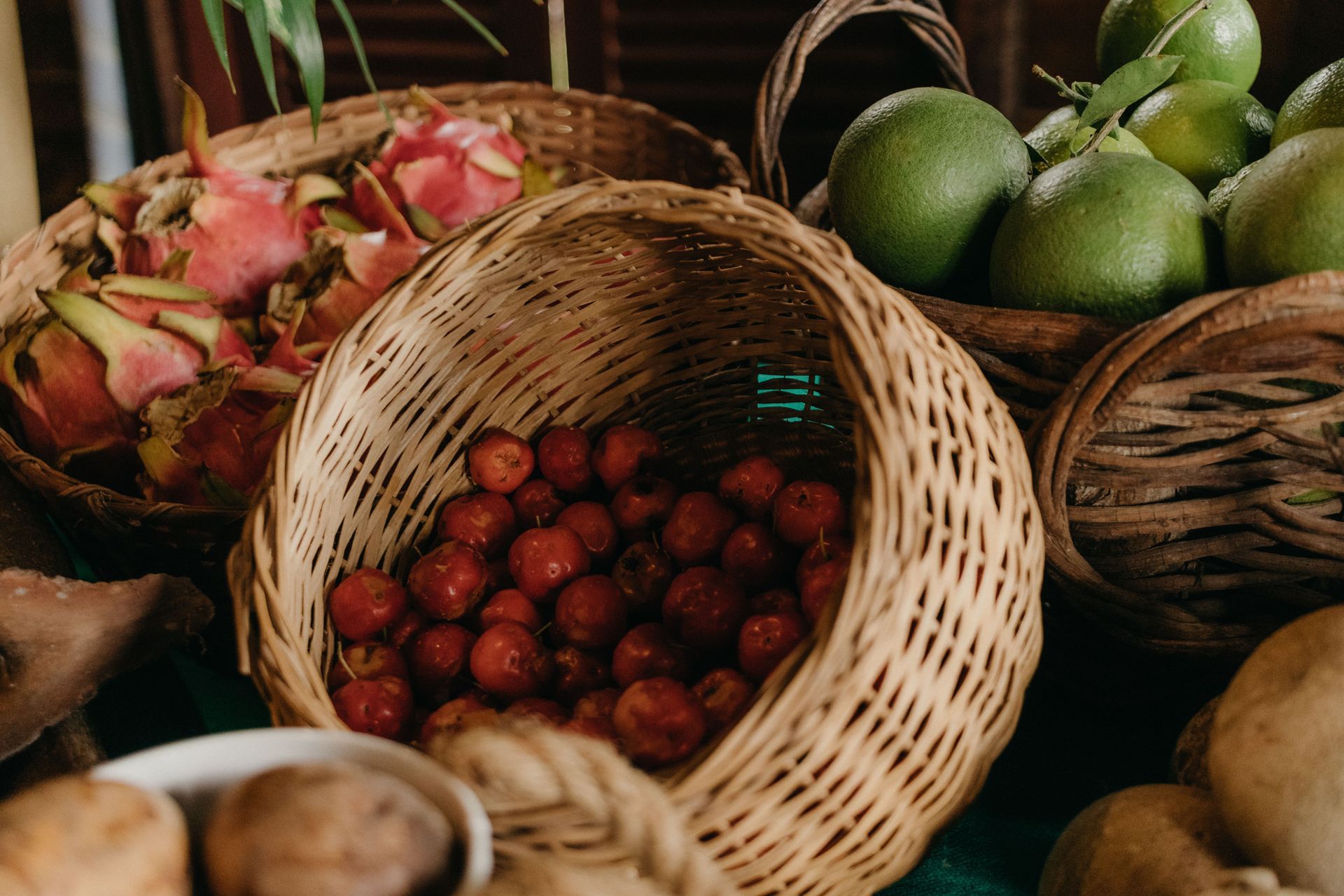
Along the flooded riverbanks of the Amazon grows a small fruit that is easy to overlook. Camu-camu begins life green, ripening through shades of red into a deep crimson-purple. Its flavour is intensely sour, which is why it has traditionally been mixed with water rather than eaten by the handful.
For many years, the fruit became known internationally for one striking feature: its exceptionally high vitamin C content. Yet modern research is beginning to suggest that camu-camu may be more interesting than a simple source of one nutrient.
Its polyphenols, pigments and other plant compounds are now being investigated for their possible influence on inflammation, the gut microbiome and metabolic liver health.
Meet the Plant
Camu-camu, botanically known as Myrciaria dubia, belongs to the Myrtaceae family—the same botanical family as guava, cloves, eucalyptus and myrtle. It is a shrub or small tree native to tropical regions of South America, including Peru, Brazil, Colombia, Ecuador, Bolivia and Venezuela. It grows particularly well in wet tropical environments and is closely associated with the margins of Amazonian rivers, lakes and seasonally flooded areas.
The berries are small and round, usually measuring approximately one to three centimetres across. As they ripen, the skin changes from green to red and then to a darker violet-purple, reflecting changes in pigments such as anthocyanins.
The relationship with water is an important part of the plant’s identity. Wild populations can spend part of the year surrounded by floodwater, and the fruit has traditionally been collected from shrubs growing close to the river.
A Fruit Shaped by the Amazon
Camu-camu is not simply a tropical crop that happens to grow in the Amazon. It is part of a river landscape. The plant is adapted to the seasonal rise and fall of the water. Its fruit is eaten by fish and other animals, helping to move seeds through the flooded ecosystem.
Historically, people could gather the berries from canoes as they travelled along the waterways.
Older accounts describe different relationships with the fruit across the Amazon. In the Peruvian Amazon, local and Indigenous communities consumed camu-camu fresh or used it in drinks. In some Brazilian regions, it was historically better known to fishing communities as bait and as an indication that fish were gathering beneath fruiting shrubs. This regional variation reminds us that there is rarely one single “traditional use” for a plant.
Traditional Preparation
Because fresh camu-camu is extremely acidic, it has often been crushed or pulped, diluted with water and sweetened to create a refreshing drink. In the Peruvian Amazon, the fruit has also been used in juices, soft drinks, jellies, ice creams, frozen treats, desserts, wines and liqueurs. Its use as a food appears to be better documented than its use as a formal medicinal preparation.
Some ethnobotanical sources also describe regional medicinal uses of the leaves, peel or fruit for colds, digestive complaints, arthritis and other conditions. These reports are interesting, but the documentation is uneven and can not be taken as proof of clinical effectiveness. The most accurate description is therefore that camu-camu has traditionally been a
local Amazonian food and drink, valued for its sharp flavour and refreshing qualities, with additional medicinal uses reported in some communities.
What Is Inside Camu-Camu?
Vitamin C is the fruit’s best-known constituent, but it is only one part of a much larger chemical mixture. Camu-camu contains several groups of biologically active compounds, including:
- anthocyanins, which contribute to the red-purple colour of the ripe fruit
- flavonols such as quercetin and myricetin
- ellagic acid and ellagitannins
- proanthocyanidins
- carotenoids
- organic acids and volatile aromatic compounds
The quantity of these constituents can vary considerably depending on where the plant was grown, the stage of ripeness, the part of the fruit used and the way it was dried, stored or extracted.
The peel and seeds may also contain a different chemical profile from the pulp. This is important because a glass of juice, a whole-fruit powder and a concentrated polyphenol extract are not chemically identical preparations.
Beyond the “Superfruit” Story
Camu-camu is often marketed as an antioxidant superfruit. Although the term is attractive, it can flatten a complex plant into a single, rather vague claim. Plant polyphenols do not necessarily work simply by travelling through the body and “neutralising free radicals.” Many are transformed by digestion and by intestinal microorganisms. Their metabolites may then influence signalling pathways, inflammatory activity, microbial ecology and communication between the intestine and other organs.
This has led researchers to investigate camu-camu through the
gut–liver axis—the two-way relationship between the intestine, its microbial inhabitants and the liver. The liver receives nutrients, microbial metabolites and other compounds arriving from the digestive tract through the portal circulation. Changes within the intestinal environment can therefore influence the metabolic and inflammatory signals reaching the liver.
The 2024 Human Trial
One of the most interesting camu-camu studies to date was a randomized, double-blind, placebo-controlled crossover trial published in Cell Reports Medicine in 2024. The study involved 30 adults with overweight and raised triglycerides. Participants consumed either
1.5 grams of a polyphenol-rich camu-camu preparation each day or a placebo for 12 weeks, before crossing over to the other intervention following a washout period. Liver fat was measured using magnetic resonance imaging.
During the camu-camu phase, liver fat decreased by 7.43%. During the placebo phase, it increased by 8.42%, producing a relative difference of 15.85% between the interventions. Levels of the liver enzymes ALT and AST also decreased during camu-camu supplementation.
The researchers also detected changes in the relative abundance of several intestinal bacterial groups. However, camu-camu did not completely restructure the microbiome, nor did it significantly change overall microbial diversity. The findings suggest a selective microbiome-modulating effect rather than a simple transformation from an “unhealthy” to a “healthy” microbiome.
Earlier Human Research
An earlier study explored whether camu-camu behaved differently from isolated vitamin C.
Twenty male smokers received either 70 millilitres of camu-camu juice or vitamin C tablets containing the same quantity of vitamin C for seven days. Several markers associated with oxidative stress and inflammation decreased in the camu-camu group but not in the vitamin C group.
Because the study was very small, short and conducted only in male smokers, it cannot establish broad clinical benefits. However, it supports an important idea: the effects of a whole fruit may not be explained by vitamin C alone. The interaction between vitamin C, polyphenols, pigments, organic acids and microbial metabolism may be more biologically relevant than any one constituent in isolation.
🌿 Key Takeaways
Camu-camu is an intensely sour Amazonian fruit that has traditionally been used in drinks and foods along the river regions of Peru.
It contains far more than vitamin C, including anthocyanins, ellagitannins, flavonols, proanthocyanidins and other polyphenols.
A small 2024 human trial found that a specific camu-camu preparation reduced liver fat and liver enzyme levels in adults with overweight and raised triglycerides, while also changing parts of the gut microbiome.
🌱 A Herbalist’s Perspective
Camu-camu is a beautiful example of why plants should not always be reduced to their most famous nutrient. Its story begins with a fruit growing at the edge of the Amazonian river. Modern science then asks a much wider question: could the complete chemical pattern of that fruit interact with the microbial and metabolic organisation of the human body?
The most interesting possibility may not be that camu-camu acts directly on one organ or one biochemical marker. It may be that its polyphenols influence the relationships between the intestine, its microorganisms and the liver.
That remains an emerging area of research—but it is precisely where this small Amazonian fruit becomes far more interesting than a vitamin C supplement.
This article is for educational purposes and does not replace individual medical assessment, diagnosis or treatment.
References
- Agrinier A-L, et al.
Camu-camu decreases hepatic steatosis and liver injury markers in overweight, hypertriglyceridemic individuals: a randomized crossover trial. Cell Reports Medicine. 2024.
- García-Chacón JM, et al.
Camu Camu (Myrciaria dubia): An Amazonian Fruit with Biofunctional Properties—A Review. ACS Omega. 2023.
- Inoue T, et al.
Tropical fruit camu-camu has anti-oxidative and anti-inflammatory properties. Journal of Cardiology. 2008.
- Kew Science.
Plants of the World Online: Myrciaria dubia.
- Andrade JS, Andrade DS.
Camu-camu: Historical rescue as a basis for its valorization in the Amazon. 2023.